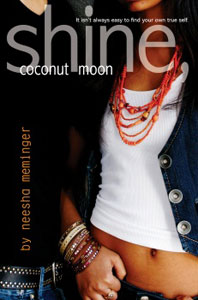
Shine, Coconut Moon by Neesha Meminger
This is another book that really deserves a longer review, but it's going to have be a super short one for now.
Sam has never known much about her heritage because her mom cut off all family ties. Shortly after 9/11, a man wearing a turban shows up at her doorstep and introduces himself as her uncle. He wanted to reconnect with family after the tragedy of 9/11 and rapidly introduces her to both her heritage and the sad intolerance of people.
Like Meminger's other novel, Jazz in Love, I really loved this book. She deftly captures both Sam's voice, and her struggle to find her place in the world. I think that any teenage could relate to Sam's struggles to accept her family and mesh her present with her past. It also dealt quite well with the racism that immediately followed 9/11. Meminger's plots and characters are engaging and believable. I can't wait for her next novel!
My favorite pastimes: reading, writing, knitting and panicking about my lack of direction in life.
Friday, May 6, 2011
Thursday, May 5, 2011
When to Stop Planning and Start Writing
Sorry for the bit of bloggy silence guys. The school year is winding down (only 2 weeks left!!!) and things are a little crazy. I have tons of testing and data stuff to do before the end of the year. It's been nuts, so posting may be slightly sporadic for the next couple of weeks, but I'll do my best!
Anyway, I've mentioned before how I'm working on my latest novel. I've been doing tons of plotting, planning and story boarding. With my first novel I just sat down and wrote. It went really well until I was about 2/3 of the way through the book. Then, I got stuck. I had no idea how to get from where I was to the ending that I envisioned. I faltered and eventually set the whole manuscript aside. With this book I was determined to be different. I've read tons about plotting, structure, character development. I've got a notebook full of ideas, plot lines and my story board (as seen at the right). I was bent on having every single scene for my novel plotted out before I wrote the first sentence.
This went well as I plugged along through the first act. I had all of my scenes laid out, scene cards done. I had character sketches and setting sketches and I was ready to rock and roll with my second act. And....I hit a huge block. I had no idea what my characters were going to do next. I sat at Borders with Cari, my lovely critique partner, for a week doing generally nothing. I stared at my sticky notes and flipped idly through my notebook, and made a big production of drinking my coffee. I whined at Cari, and bless her soul, she finally shut me up and told me to just start writing.
I did, and finished my first chapter today. It's not pretty, but it's on paper and a first draft is done. I'm still feeling a little daunted by the second act, but I'm getting there and I at least feel like I'm making some progress.
So my question is this, how do you write? Or do make any decision. My husband is currently over-thinking what car he's going to buy. :) Do you just start writing? Plot is all out? Some combination of both? How do you decide when you have planned enough and just jump in?
Anyway, I've mentioned before how I'm working on my latest novel. I've been doing tons of plotting, planning and story boarding. With my first novel I just sat down and wrote. It went really well until I was about 2/3 of the way through the book. Then, I got stuck. I had no idea how to get from where I was to the ending that I envisioned. I faltered and eventually set the whole manuscript aside. With this book I was determined to be different. I've read tons about plotting, structure, character development. I've got a notebook full of ideas, plot lines and my story board (as seen at the right). I was bent on having every single scene for my novel plotted out before I wrote the first sentence.
This went well as I plugged along through the first act. I had all of my scenes laid out, scene cards done. I had character sketches and setting sketches and I was ready to rock and roll with my second act. And....I hit a huge block. I had no idea what my characters were going to do next. I sat at Borders with Cari, my lovely critique partner, for a week doing generally nothing. I stared at my sticky notes and flipped idly through my notebook, and made a big production of drinking my coffee. I whined at Cari, and bless her soul, she finally shut me up and told me to just start writing.
I did, and finished my first chapter today. It's not pretty, but it's on paper and a first draft is done. I'm still feeling a little daunted by the second act, but I'm getting there and I at least feel like I'm making some progress.
So my question is this, how do you write? Or do make any decision. My husband is currently over-thinking what car he's going to buy. :) Do you just start writing? Plot is all out? Some combination of both? How do you decide when you have planned enough and just jump in?
Friday, April 29, 2011
The Iron Fey- Julie Kagawa
The Iron Fey Trilogy (and a half) by Julie Kagawa
So, rather than attempt to review each of these books individually, I'm just going to give you my opinion of the whole series. Not that each of these books isn't worthy of it's own review, each is, I just know that if I try to make it harder for me to keep up this blog, it will never stay current. So, four books, one review.
Since I can't really tell you about the plots of all of the books without giving away spoilers for the earlier books, I'll just give an overall concept for the series. Megan Chase is half faery; her father is Oberon (yes, that Oberon) Summer King. Her little brother has been stolen and taken to faery, and Megan must go to save him. Meanwhile, the Iron Fey are taking over faery and slowly killing both Summer and Winter's lands.
I really liked this series. I loved the way that Kagawa wove known stories of faeries into this new tale. I loved all the Midsummer Night's Dream references, including Puck as Megan's best friend. (Probably because I love Midsummer Night's Dream so much) I thought the love triangle was believable, even though I was irritated that it was YET AGAIN a fantasy love triangle. I felt like Megan was an actor in her own story and definitely not passive. I also loved how Kagawa incorporated modern day into the world of faeries. It was an interesting take on a very old idea and I think it worked quite well.
These were definitely quick reads. I don't know that you would necessarily need to read Winter's Passage. It bridges the gap between the first and second book and follows Megan on a short journey. It was quite nice, and I liked the novella, but much of it was covered again at the beginning of the second book. If you like YA Fantasy or faeries at all, they are fun books to read!
Wednesday, April 27, 2011
The Unsuspecting Mage- Brian Pratt
The Unsupecting Mage by Brian Pratt
I think I will in fact be able to keep this review very, very short. This book is terrible. Don't read it.
Wow. Now, I feel bad saying that. I'm sure that someday I will be reading reviews of my own book (hopefully) and I'll come across someone that doesn't like my own writing and you know what, I'll probably be devastated. I hope, however, that I'll be able to take whatever criticism they offer and move on. Regardless, I just don't have really anything nice to say about this book.
To be fair, I don't think that I am the demographic that this book is geared towards. I'm not a nerdy high school boy, or a man who once was a nerdy high school boy. A short summary is this: James, a high school student looking for a job, replies to an ad in the paper about someone wanting to learn magic. At the office he enters a door and is deposited into some Middle English-type world, where he learns to use his magic, puts all of his Dungeons and Dragons time to good use and gets in a lot of fights. This book read like one long D&D script, and I've never played D&D, or any other game like that. the writing was drab and terrible. The book itself is a case against self publishing- the editing is awful and there were countless typos and errors. Granted, the book is free, but I still don't think it was worth the time. A friend of mine recommended it to me, with the caveat that there were typos and such, but he thought the plot was great. I did not. People who love playing World of Warcraft and other such fantasy role-playing games might like it because that's how it read. Very episodic, lots of magic, finding trinkets and fights, no real plot or character arc.
Now, if that sort of thing appeals to you, then by all means check it out. It's free for Kindle, so you're not going to waste anything other than your time, but it really was not my cup of tea, or bourbon, or really anything.
I think I will in fact be able to keep this review very, very short. This book is terrible. Don't read it.
Wow. Now, I feel bad saying that. I'm sure that someday I will be reading reviews of my own book (hopefully) and I'll come across someone that doesn't like my own writing and you know what, I'll probably be devastated. I hope, however, that I'll be able to take whatever criticism they offer and move on. Regardless, I just don't have really anything nice to say about this book.
To be fair, I don't think that I am the demographic that this book is geared towards. I'm not a nerdy high school boy, or a man who once was a nerdy high school boy. A short summary is this: James, a high school student looking for a job, replies to an ad in the paper about someone wanting to learn magic. At the office he enters a door and is deposited into some Middle English-type world, where he learns to use his magic, puts all of his Dungeons and Dragons time to good use and gets in a lot of fights. This book read like one long D&D script, and I've never played D&D, or any other game like that. the writing was drab and terrible. The book itself is a case against self publishing- the editing is awful and there were countless typos and errors. Granted, the book is free, but I still don't think it was worth the time. A friend of mine recommended it to me, with the caveat that there were typos and such, but he thought the plot was great. I did not. People who love playing World of Warcraft and other such fantasy role-playing games might like it because that's how it read. Very episodic, lots of magic, finding trinkets and fights, no real plot or character arc.
Now, if that sort of thing appeals to you, then by all means check it out. It's free for Kindle, so you're not going to waste anything other than your time, but it really was not my cup of tea, or bourbon, or really anything.
Monday, April 25, 2011
Even More- Rules for Writing
It seems that everyone has some opinion on writing, actual writers or not. Any time I tell people that I'm an author, which I tend not to do, they have some sort of opinion on what I should be writing and when I should be writing and how I should be writing. Every one's a critic. However, I do rather like reading actual author's rules of writing. Taking advice from someone who has been there before is far easier than taking advice from someone who will never even try to go down that road.
So, without further ado, here are Elmore Leonard's Rules for Writing, shamelessly lifted from Melody Godfred over at Write in Color. I found her website with StumbleUpon, which is super fun, but such a time suck. Just FYI... you've been warned. Also, if you, like me, had no idea who Elmore Leonard is, here's a short bio of him and his works. My own opinions on each of these rules follows in italics. What, you thought I'd let everyone else have an opinion and keep mine to myself? Ha.
1 Never open a book with weather. This seems reasonable, and seems to follow with the understood rule to never open a book with your character waking up. You've got to grab the reader and immediately give her someone she cares about. I do think that an excellent example of this is Graceling, where we are thrust immediately into the action with the main character.
2 Avoid prologues: they can be annoying, especially a prologue following an introduction that comes after a foreword. Mmm.... maybe. I waver on this rule quite a bit. Some prologues I think are fantastic, especially if they give me a good hint at how the book is going to end, but other times they are annoying. I think prologues must be treated very delicately, because a bad one can definitely stink up the whole novel.
3 Never use a verb other than “said” to carry dialogue. OH man... yes, yes, yes. This totally drives me nuts and smacks of a middle school child with their first thesaurus. I hate when writers use all kinds of ridiculous dialogue tags. It's just bad writing. SHOW that your character is angry, or grumbly, or gaspy, whatever, don't tell me.
4 Never use an adverb to modify the verb “said” We're always told that adverbs are the death of writing. I think it probably true, but definitely something I have a hard time with. My writing isn't strong enough without adverbs, so I know that is something I personally have to work on. (Disclosure: I just had to bite back using like 5 adverbs in that last comment... ugh, really need to work on it!)
5 Keep your exclamation points under control. This also reminds me of middle schoolers. I can't tell you how many, "This Summer I Rode a Roller Coaster!!!!!!" stories I've had to read in my career, all dripping with exclamation points. No, just no.
6 Never use the words “suddenly” or “all hell broke loose”. Heee... this reminds me of a conversation the lovely Cari (my writing partner) and I were having the other day about character motivation. It seems, if you have to use "suddenly" and the likes, then there hasn't been sufficient motivation set up for the character. If something is "suddenly" happening to the character, then just show it!
7 Use regional dialect, patois, sparingly. Hmmm... this makes me think of Their Eyes Were Watching God, which is riddled with dialect, but it works. I've heard dialect described like salt. A little can really accentuate a plot and characters but too much and no one can stomach it.
8 Avoid detailed descriptions of characters Well, this one I may have to disagree with, or at least, partially disagree with. I love having a clear picture in my head of the characters and the setting. I like it when the author gives me most of that picture. It's not that I don't have an imagination and can't come up with something myself, but if the author has someone in mind, I want to have that same person in mind. That being said, I don't want a long monologue of description because that is rarely entertaining. Also, get the description out of the way up front, in the first few chapters at least. I hate when I've formed a picture of a character, only to find out halfway through the book some key detail that is not how I originally pictured it. It's so jarring. I never went to see the movie version of the book Eragon by Christopher Paolini because when the movie came our, Eragon was blond and the whole time I'd been reading the book I thought he was a brunette. Small detail? Yes, but it bothered the heck out of me.
9 Don’t go into great detail describing places and things Again, I have mixed feelings. I love beautiful sweeping descriptions, but I think these are probably better suited to lovely works of literary fiction where the plot takes a backseat to the characters and their changes. I do like description though and being able to get a clear sense of the place.
10 Try to leave out the part that readers tend to skip Now this one really made me think. What parts of novels do I skip? I honestly couldn't come up with a lot. I know that when I'm getting close to the end of a book or close to what appears to be the climax that I'll skip dialogue or descriptions that seem unimportant because I want to find out what happens, but that is usually because the writer has gotten me so excited about the plot that I just can't stand to wait any longer than necessary.
So, without further ado, here are Elmore Leonard's Rules for Writing, shamelessly lifted from Melody Godfred over at Write in Color. I found her website with StumbleUpon, which is super fun, but such a time suck. Just FYI... you've been warned. Also, if you, like me, had no idea who Elmore Leonard is, here's a short bio of him and his works. My own opinions on each of these rules follows in italics. What, you thought I'd let everyone else have an opinion and keep mine to myself? Ha.
1 Never open a book with weather. This seems reasonable, and seems to follow with the understood rule to never open a book with your character waking up. You've got to grab the reader and immediately give her someone she cares about. I do think that an excellent example of this is Graceling, where we are thrust immediately into the action with the main character.
2 Avoid prologues: they can be annoying, especially a prologue following an introduction that comes after a foreword. Mmm.... maybe. I waver on this rule quite a bit. Some prologues I think are fantastic, especially if they give me a good hint at how the book is going to end, but other times they are annoying. I think prologues must be treated very delicately, because a bad one can definitely stink up the whole novel.
3 Never use a verb other than “said” to carry dialogue. OH man... yes, yes, yes. This totally drives me nuts and smacks of a middle school child with their first thesaurus. I hate when writers use all kinds of ridiculous dialogue tags. It's just bad writing. SHOW that your character is angry, or grumbly, or gaspy, whatever, don't tell me.
4 Never use an adverb to modify the verb “said” We're always told that adverbs are the death of writing. I think it probably true, but definitely something I have a hard time with. My writing isn't strong enough without adverbs, so I know that is something I personally have to work on. (Disclosure: I just had to bite back using like 5 adverbs in that last comment... ugh, really need to work on it!)
5 Keep your exclamation points under control. This also reminds me of middle schoolers. I can't tell you how many, "This Summer I Rode a Roller Coaster!!!!!!" stories I've had to read in my career, all dripping with exclamation points. No, just no.
6 Never use the words “suddenly” or “all hell broke loose”. Heee... this reminds me of a conversation the lovely Cari (my writing partner) and I were having the other day about character motivation. It seems, if you have to use "suddenly" and the likes, then there hasn't been sufficient motivation set up for the character. If something is "suddenly" happening to the character, then just show it!
7 Use regional dialect, patois, sparingly. Hmmm... this makes me think of Their Eyes Were Watching God, which is riddled with dialect, but it works. I've heard dialect described like salt. A little can really accentuate a plot and characters but too much and no one can stomach it.
8 Avoid detailed descriptions of characters Well, this one I may have to disagree with, or at least, partially disagree with. I love having a clear picture in my head of the characters and the setting. I like it when the author gives me most of that picture. It's not that I don't have an imagination and can't come up with something myself, but if the author has someone in mind, I want to have that same person in mind. That being said, I don't want a long monologue of description because that is rarely entertaining. Also, get the description out of the way up front, in the first few chapters at least. I hate when I've formed a picture of a character, only to find out halfway through the book some key detail that is not how I originally pictured it. It's so jarring. I never went to see the movie version of the book Eragon by Christopher Paolini because when the movie came our, Eragon was blond and the whole time I'd been reading the book I thought he was a brunette. Small detail? Yes, but it bothered the heck out of me.
9 Don’t go into great detail describing places and things Again, I have mixed feelings. I love beautiful sweeping descriptions, but I think these are probably better suited to lovely works of literary fiction where the plot takes a backseat to the characters and their changes. I do like description though and being able to get a clear sense of the place.
10 Try to leave out the part that readers tend to skip Now this one really made me think. What parts of novels do I skip? I honestly couldn't come up with a lot. I know that when I'm getting close to the end of a book or close to what appears to be the climax that I'll skip dialogue or descriptions that seem unimportant because I want to find out what happens, but that is usually because the writer has gotten me so excited about the plot that I just can't stand to wait any longer than necessary.
Friday, April 22, 2011
How to Turn a Book into a Vase
So, some of you may have guessed based on the title of this blog, regardless of the lack of knitting content, that I'm a bit of a crafty person. I've always loved making things. In my old age, I've tended to focus on knitting just so I have a focus, but I love to paint, draw, make ornaments and decorations and I'm planning on learning to use my new spinning wheel and sewing machine this summer. At any rate, because of my inherent craftiness I thought I would share this amazing video on how to turn an old book into a vase. I don't necessarily advocate tearing up books, but I'm sure I could find some random ones at the thrift store to sacrifice. I think these are super cute and I would love to have a little collection of them filled with pretty faux daisies in my classroom. Maybe I'll take a break from knitting for a bit to churn out a few. :)
The how-to video below is via Green Upgrader, which I just stumbled upon, but it looks like a super fun website. Anyway... enjoy! And please share pics if you decide to make some vases for yourself. :)
Monday, April 18, 2011
Born Confused- Tanjua Desai Hidier
Born Confused by Tanuja Desai Hidier
A super short review for a super long book. Born Confused is sort of the epic quest of one Jersey-born Indian girl who doesn't quite fit in to either her American or Indian culture. Dimple had never been that interested in her Indian roots, until her beautiful blonde friend Gwynn starts to take over her culture, including the boy Dimple's parents have set her up with. Over the course of 500 very long pages, Dimple finds herself, her culture, love and friendship.
I had a bit of a hard time with this book. I loved the main character, Dimple. I liked her family and the plot, but the book felt too long. To be honest, I'm not sure what I would cut, because it all felt relatively important when I was reading it, but it was a struggle to finish because it just dragged. I liked the friction between Dimple and her Indian heritage and Gwynn. I think that the book is quite relatable for any girl who doesn't feel like she fits in, but the prose lumbered.
A super short review for a super long book. Born Confused is sort of the epic quest of one Jersey-born Indian girl who doesn't quite fit in to either her American or Indian culture. Dimple had never been that interested in her Indian roots, until her beautiful blonde friend Gwynn starts to take over her culture, including the boy Dimple's parents have set her up with. Over the course of 500 very long pages, Dimple finds herself, her culture, love and friendship.
I had a bit of a hard time with this book. I loved the main character, Dimple. I liked her family and the plot, but the book felt too long. To be honest, I'm not sure what I would cut, because it all felt relatively important when I was reading it, but it was a struggle to finish because it just dragged. I liked the friction between Dimple and her Indian heritage and Gwynn. I think that the book is quite relatable for any girl who doesn't feel like she fits in, but the prose lumbered.
Subscribe to:
Posts (Atom)
